

Where Do Fetishes Come From?
...and are you sure you want to know?

This article was originally published in Le Point on 24.11.2025
Among the more enduring mysteries of human sexuality are the developmental origins of erotic preferences. This applies not only to more superficial facets of physical appearance—say, whether you’re into blondes or brunettes, or those with a bit of meat on their bones or the more svelte physiques, and so on—but also very specific kinks and fetishes. Why little Jean grows up to be attracted only to, I don’t know, giantesses over 6’5”, or little Marie becomes a whip-wielding sadomasochist twenty years later, scientists can only venture a guess.
After all, and fortunately so, it’s not as though researchers can conduct controlled experiments with children to pinpoint what makes one veer off in wild or unusual directions at sexual maturity. Most sexologists, however, believe the paraphilias (Greek for “love outside the norm”) don’t just come from out of the blue, but are linked to early experiences. Adults with fetishes can often relay surprisingly specific incidents from their past that, they say, seem to have ignited their atypical desires. In my 2013 book Perv, I describe several such cases, such as an amputee fetishist who’d grown up surrounded by his physician father’s medical textbooks that included photos of nude women with missing limbs, or a man really into toes whose mother innocently asked her son to massage her aching feet.
There are also clear findings from animal models of “sexual imprinting.” In one classic experiment, a mother rat’s teats were coated with a strong lemony scent, so that her pups got a hefty dose of this odor as they suckled. When those same male pups reached adulthood, they would only mount and ejaculate to female rats with the same citrusy smell as their mom. In another study with male zebra finch hatchlings, the beaks of the parents were painted with either red or orange nail polish. As adults, these males displayed a mating preference for females whose beaks matched their mother’s—but not their father’s—beak color. There was even evidence of a “peak shift” in their sexual decision-making, whereby these adult males were even more attracted to brighter, more extreme versions of their mother’s beak color. When it comes to birds, in fact, sexual imprinting “seems the rule rather than exception,” according to one pair of researchers, “[it] has been present wherever it has been looked for.”
Then there are the cross-fostering studies, showing that when an animal is reared by another species, it grows up to be sexually aroused by opposite-sex members of the foster species, not its own. The most famous example are the sheep-goat studies from the 1990s, in which sheep raised by goats were shown to be into goats, and goats raised by sheep were into sheep. The fictional story of The Jungle Book aside, no cross-fostering studies have been done with human infants. But some findings suggest that people raised by adoptive parents tend to end up with partners who more closely resemble them than their biological parents. Also close on the phylogenetic tree is an anecdote involving a chimpanzee named Lucy, who in the 1960s was raised “as a daughter” in the home of psychologist Maurice Temerlin as part of that era’s ill-fated sign-language studies with apes. When she got older, Temerlin reports, Lucy would spread the glossy pages of a Playgirl magazine on the floor and place her swollen genitals on the image of the model’s penis. (How this situation came to be begs some questions.)
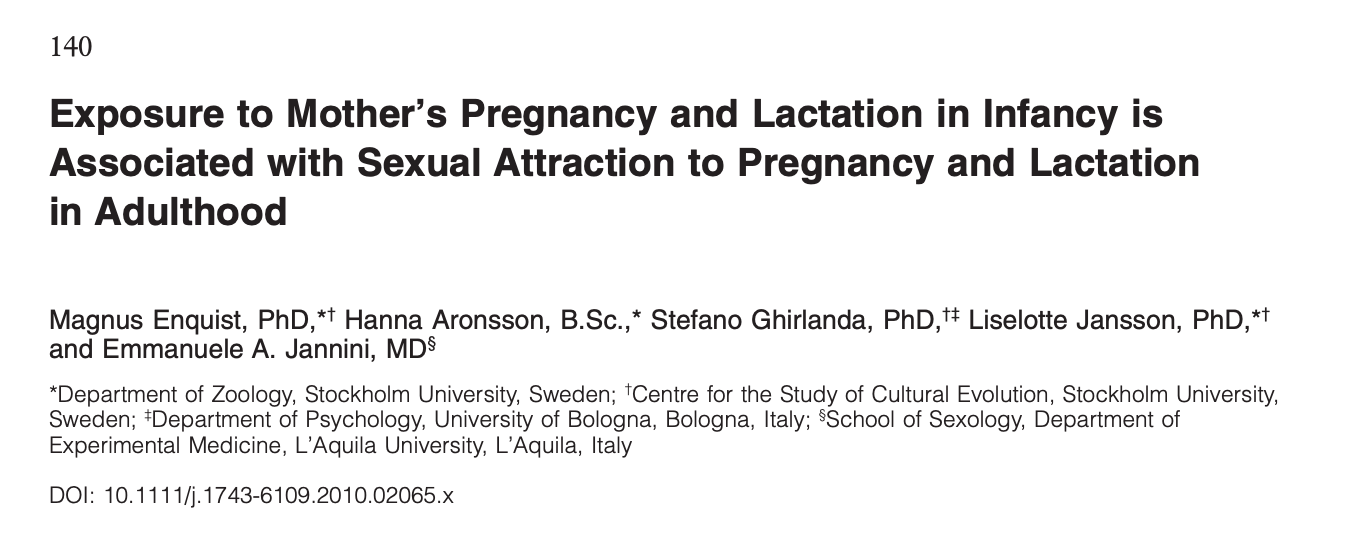
In any event, what such animal studies suggest is that, across a wide range of species, the effects of sexual imprinting in early development on adult sexual preferences may be grossly underestimated. Again, the application to humans is unclear, but we are, of course, no less animal than other animals. Ethically, researchers can’t apply a coat of citrusy paint to a human female’s lactating breasts, or swap out orangutan babies with human newborns, then wait a few decades to see if these species-atypical experiences alter the adult subject’s sexual desires. Yet some investigators have nonetheless employed creative ways to test for sexual imprinting in human beings. Consider one such study by the Swedish ethologist Magnus Enquist and his colleagues published in the Journal of Sexual Medicine back in 2011. The authors lay out the central logic behind their study, explaining that:
Rather than manipulating children’s experiences, we must rely on ‘natural experiments.’ That is, we try to identify a sexual preference in adults that can plausibly be linked to childhood exposure to a specific stimulus. The sexual imprinting hypothesis predicts that adults with the preference have a higher probability of childhood exposure. To test this hypothesis, the preference studied should fulfill two requirements. First, it must be possible to ascertain whether the individual has been exposed to the stimulus in childhood, precluding a reliance on the recall of very early experiences. Ideally, the exposure should cover only a part of childhood, and it should be possible to estimate when it occurred. Second, it must be possible to find individuals lacking the exposure.
The particular “sexual preference” that Enquist and his team settled on—an erotic attraction to pregnant and/or lactating women—was quite brilliant, fullfilling the above criteria to a tee. In households with multiple children, are first-borns more likely than their younger siblings to develop an adult sexual preference for pregnant or lactating women?
Under the null hypothesis that early exposure does not influence sexual development, individuals with the preferences should be equally frequent in all birth orders. The sexual imprinting hypothesis, on the other hand, predicts that individuals with the preference should preferentially appear in early birth orders, i.e., have more younger siblings than expected by chance. In a family with two children, for example, only the older child has been exposed to the mother’s pregnancy and/or lactation.
Where does an industrious scholar studying sexual imprinting in humans find maieusiophiles (pregnancy fetishists) and galactophiles (breastfeeding fetishists)? Online, of course. Over a six-year period (2003-2009), questionnaires were distributed to members of adult newsgroups and Yahoo! discussion forums catering to these very specific audiences (e.g., alt.sex.fetish.breastmilk, Lactators, Pregnant Ladies, etc.). A total of 2,082 respondents completed the survey, and their answers provided clear support for the sexual imprinting hypothesis. Those with a sexual attraction to pregnant or lactating women had younger siblings significantly more often than would be expected by chance. This was true for both male and female (15% of sample) respondents, and the pattern was also apparent for those with just one younger sibling or multiple younger siblings. Actually, first-borns with multiple younger siblings were more frequent in the fetishist sample than those with fewer, suggesting a sort of dosage effect of early childhood exposure to their mother’s successive pregnancies.
Intriguingly, by asking the participants about the difference in age between themselves and their siblings, the researchers were also able to ascertain a probable “sensitive period” in development when children are especially receptive to sexual imprinting. The fetish emerged most often when the age difference was between 1.5 and 5 years. “Outside of this range,” write the authors, “there is no significant effect of exposure on sexual preference.”
There are still more questions than answers with this line of research, of course. Enquist and his colleagues’ study is a rather extreme example of sexual imprinting, but it serves its empirical purpose. The intent here is certainly not to scare young mothers into shielding their kids from “exposure” to something as natural as pregnancy and breastfeeding for fear of them becoming sex deviants. Obviously, the vast majority of people with younger siblings—many of whom I’m sure are reading this article and will be eager to tell me exactly this—aren’t spending their spare time on alt.sex.fetish.breastmilk or loitering around the obstetrics ward on a lonely Saturday night.
It may be that the disposition for sexual imprinting is itself a highly variable trait, with some individuals being more wax to retain such early childhood effects than others. We know from those earlier animal studies, for instance, that males of all species are much more susceptible to the lasting effects of sexual imprinting than females, a fact strikingly aligned with human sex differences in the frequency of fetishes and paraphilic disorders. As the psychologist Roy Baumeister wrote, “Once a man’s sexual tastes emerge, they are less susceptible to change or adaptation than a woman’s.” To the extent that a person can only get aroused by something other than a reproductively viable adult human being, it’s hard to see how such a trait wouldn’t have been quickly weeded out by evolution. If you haven’t put two and two together, for instance, being aroused solely by women who are already pregnant is kind of a dead-end for your genes.
Still, I suspect that the role of sexual imprinting on our adult sexual desires is probably far more common—and far more powerful—than most of us will ever realize. Or want to.
Like what you read? Toss a tip in the jar—any amount that makes sense for you—so I can keep overthinking things on your behalf.
The Enquist pregnancy/lactation imprinting study is methodologically clever. Using birth order as a proxy for exposure sidesteps the recall bias issue that plagues most retrospective research on early development. The 1.5-5 year sensitive period finding aligns with what we know about other forms of critical period learning. That cross-fostering stuff with sheep and goats is fascinating too, though the Lucy anecdote feels more like a cautionary tale about those 60s-70s ape language experiments than evidence for anything specific. I worked with developmental psych data for abit and dosage effects like the multiple younger siblings pattern are usually pretty robust when they show up.